

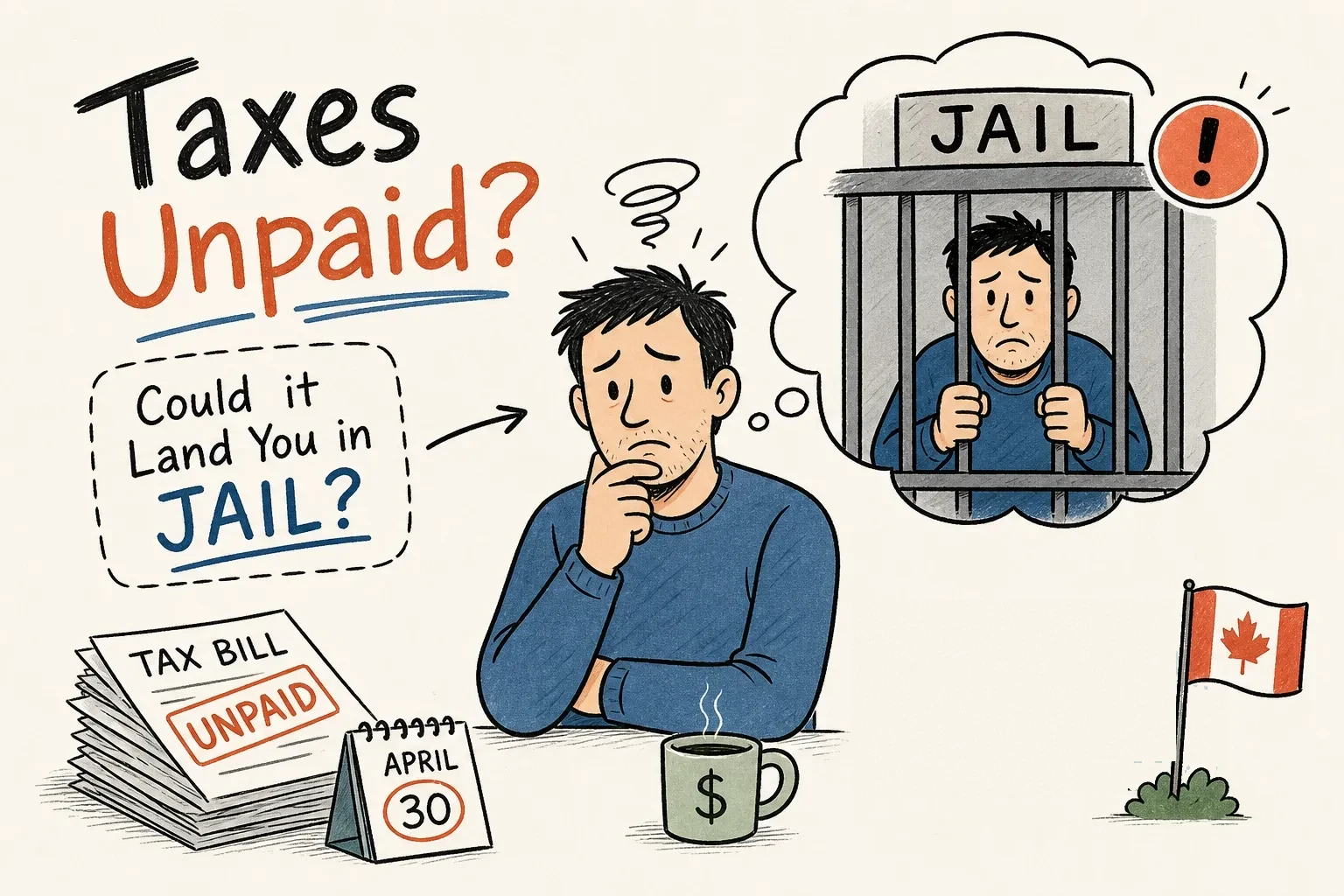
Yes, but jail is rare and usually tied to tax evasion rather than inability to pay. Failing to file is an offence under section 238 of the Income Tax Act, with fines of $1,000 to $25,000 and up to 12 months in prison. Tax evasion under section 239 carries fines of 50% to 200% of tax evaded and up to five years. The Voluntary Disclosures Program and catch-up tax filing reduce this risk. See what happens if you don’t file.
Can you go to jail for not paying taxes in Canada? If you simply can’t pay, no. For the vast majority of Canadians with unpaid taxes, jail is not a realistic outcome. The fear is understandable, and the CRA’s enforcement language can sound alarming until you understand how its powers actually get used. But there is a clear legal line between owing the Canada Revenue Agency money and deliberately defrauding the government, and most people asking this question are standing firmly on the safe side of that line. Not filing a return at all is a separate offence, covered below.
The real risk of unpaid taxes is financial, not criminal. Penalties, compounding interest, garnishments, and property liens are what actually happen when a tax balance goes unaddressed. Those consequences are serious, and they escalate faster than most people expect, a taxpayer who misses a deadline can see late-filing penalties and daily interest charges stack up significantly within just a few months. But they are a civil matter, not a criminal one. Understanding that distinction is what this article is about.
At Adian Professional Corporation, a CPA firm specializing in corporate tax and compliance for incorporated businesses and CCPCs, this question comes up regularly. Business owners who miss a T2 filing deadline or fall behind on a tax balance sometimes assume they are on the edge of something criminal. In almost every case, they are not. But the confusion itself causes problems, so it is worth laying out exactly where the legal lines sit, what CRA enforcement actually looks like in practice, and what your real options are if you are already behind.
Can you go to jail for not paying taxes in Canada? The legal reality
This is the foundational point. Owing the CRA money and evading taxes are treated as completely separate legal categories under Canadian law. One is a civil obligation. The other is a criminal offence. Most Canadians who owe back taxes, filed late, or underreported income through an honest mistake are dealing with a civil matter.
Civil tax debt: what it actually means
When a taxpayer owes money to the CRA and has not paid, that is a debt. The CRA pursues it through its collections division using standard civil enforcement tools. No one is charged with a crime simply for owing a balance they did not pay. The process is frustrating and can have real financial consequences, but it is not a path to a courtroom on criminal charges. The penalties, interest and collection steps are covered in what happens if you don’t file taxes in Canada.
Tax evasion: when it crosses into criminal territory
Tax evasion is the deliberate, intentional act of misrepresenting information to reduce a tax liability. The CRA’s Criminal Investigations Program exists specifically to address conduct like hiding income, claiming false deductions, destroying records, and filing fraudulent returns. The operative word is intent. A mistake is not evasion. A calculated lie is. That distinction matters enormously for how the CRA responds and what consequences are on the table.
What the Income Tax Act actually says about criminal penalties
Two sections of the Income Tax Act govern criminal consequences for tax non-compliance. They are worth understanding in plain terms, not because most readers will ever face them, but because knowing what they actually require makes the risk assessment much clearer.
Section 238: failure to file or comply
Under section 238, failing to file a required return is an offence. On summary conviction, the penalty is a fine of $1,000 to $25,000, or that fine plus up to 12 months in jail. The court can also order you to file. That sounds serious. In practice, though, criminal prosecution for ordinary late filing is rare. Pursuing a prosecution requires time, resources, and a formal referral to the Public Prosecution Service of Canada. For someone who simply filed late, the CRA will use civil penalties rather than criminal proceedings in the overwhelming majority of cases.
Section 239: wilful evasion and the real criminal threshold
Section 239 covers deliberate tax evasion. On summary conviction, the fine is 50% to 200% of the tax evaded, and the court can add up to two years in jail. If the Crown proceeds by indictment, the fine is 100% to 200% and the jail term can be up to five years. Tax fraud under the Criminal Code carries up to 14 years, according to the CRA. The standard of proof required is “beyond a reasonable doubt,” the same threshold used in any criminal trial. That is a high bar by design, and the CRA does not clear it without strong evidence of intentional, deliberate fraud. Honest errors, sloppy bookkeeping, and even aggressive but disclosed tax positions do not meet that standard.
When can you go to jail for unpaid taxes in Canada? How rare prosecution actually is
Criminal tax prosecution in Canada is selective, slow, and genuinely uncommon. The numbers tell a story that most anxious taxpayers have never seen, and they are worth taking seriously.
The CRA’s actual prosecution numbers
Over the five-year period from April 2020 to March 2025, the CRA recorded 106 convictions with sentencing. Of those, 49 individuals were jailed for a combined total of more than 98 years, with $24.5 million in court-imposed fines tied to over $39 million in federal tax evaded. The CRA says its criminal investigations are complex and take a significant amount of time. In a country of roughly 40 million people, that is a very small number of cases.
Who the CRA actually goes after
Criminal investigations target clear, deliberate fraud. The cases that end up in court involve false donation receipts, offshore income concealment, fabricated business expenses at scale, and tax preparers filing fraudulent returns on behalf of clients. A business owner who missed two years of T2 filings because their accountant dropped the ball is not in the same universe as a professional tax fraud scheme. The CRA’s resources are finite and its criminal investigations team uses them accordingly.
Your real options when you already owe the CRA
If you can’t pay in full, the CRA offers payment arrangements. Interest keeps running, but an active plan generally stops collection from escalating while you keep to it.
If returns or income are missing, the Voluntary Disclosures Program can protect you from prosecution for what you disclose, as long as the CRA isn’t already looking at it. You still owe the tax. How the program works, and what to do when you can’t pay, are covered in I haven’t filed taxes in 10 years in Canada.
If a criminal investigation has already started, speak to a tax lawyer before anything else.
The cleanest way to avoid this conversation entirely
This is worth saying directly, especially for incorporated business owners: most of what this article describes becomes irrelevant when you have accurate, complete, and timely corporate tax filings on record every year.
If you own a corporation
A corporation’s T2 is a return like any other, so a corporation that doesn’t file is in the same position as a person who doesn’t. Under section 242 of the Income Tax Act, if a corporation commits an offence, any officer or director who directed, authorized, agreed to or took part in it is guilty of the same offence, whether or not the corporation itself is prosecuted. Keeping the T2 corporate tax return filed every year keeps both the company and its directors clear of this.
Why proactive corporate tax compliance changes your risk profile
A corporation with correct and current T2 filings gives the CRA very little to question. Every applicable schedule is filed, RDTOH and GRIP balances are tracked properly, income is fully reported, and there are no unexplained gaps in the record. The risk of a serious audit drops significantly. And the risk of anything approaching criminal territory, the kind of deliberate, wilful evasion that the CRA actually refers for prosecution, is substantially reduced for a business operating with complete, accurate records. Compliance is not just about avoiding penalties. It is about keeping the corporation off the CRA’s radar before scrutiny becomes an issue.
Why specialist-level filing matters more than most incorporated owners realize
Not all T2 filings are equal in quality. A generalist accountant who files a technically incomplete return, misses an applicable schedule, or misclassifies a transaction can create inconsistencies that attract CRA attention the client never anticipated. Adian Professional Corporation handles T2 corporate tax filing exclusively for CCPCs and incorporated businesses, with every return reviewed at the senior CPA level before electronic filing. For incorporated business owners who want corporate tax compliance handled correctly from the start, working with a firm that specializes narrowly in this area is the most straightforward way to keep the corporation in good standing. Get in touch with our team if you want to understand what that looks like for your corporation specifically.
The bottom line
Can you go to jail for not paying taxes in Canada? In the vast majority of cases, no. Jail is a realistic outcome for deliberate, proven evasion: falsified records, hidden income, fraudulent filings, and intentional deception. Not filing at all is a separate offence that can carry jail time, but prosecution for it is rare. Owing a balance or missing a filing deadline does not put you in that category. The real consequences of unpaid tax debt are financial: late-filing penalties, daily interest on overdue balances, and civil collection action that can reach your wages, bank account or property.
Those consequences are serious, but they are manageable if you respond to them rather than ignore them. Payment arrangements and the Voluntary Disclosures Program both exist precisely because the CRA would rather collect what it is owed than spend resources on criminal prosecution. Use those tools early, before the situation escalates. If more than one year is open, start with catch-up tax filing.
If you run an incorporated business, the most effective long-term strategy is not damage control after the fact. It is accurate, specialist-level corporate tax filing from day one. That approach eliminates the conditions under which CRA scrutiny becomes a problem in the first place, and it means you will never need to ask whether jail for unpaid taxes in Canada is a realistic risk for your situation.