

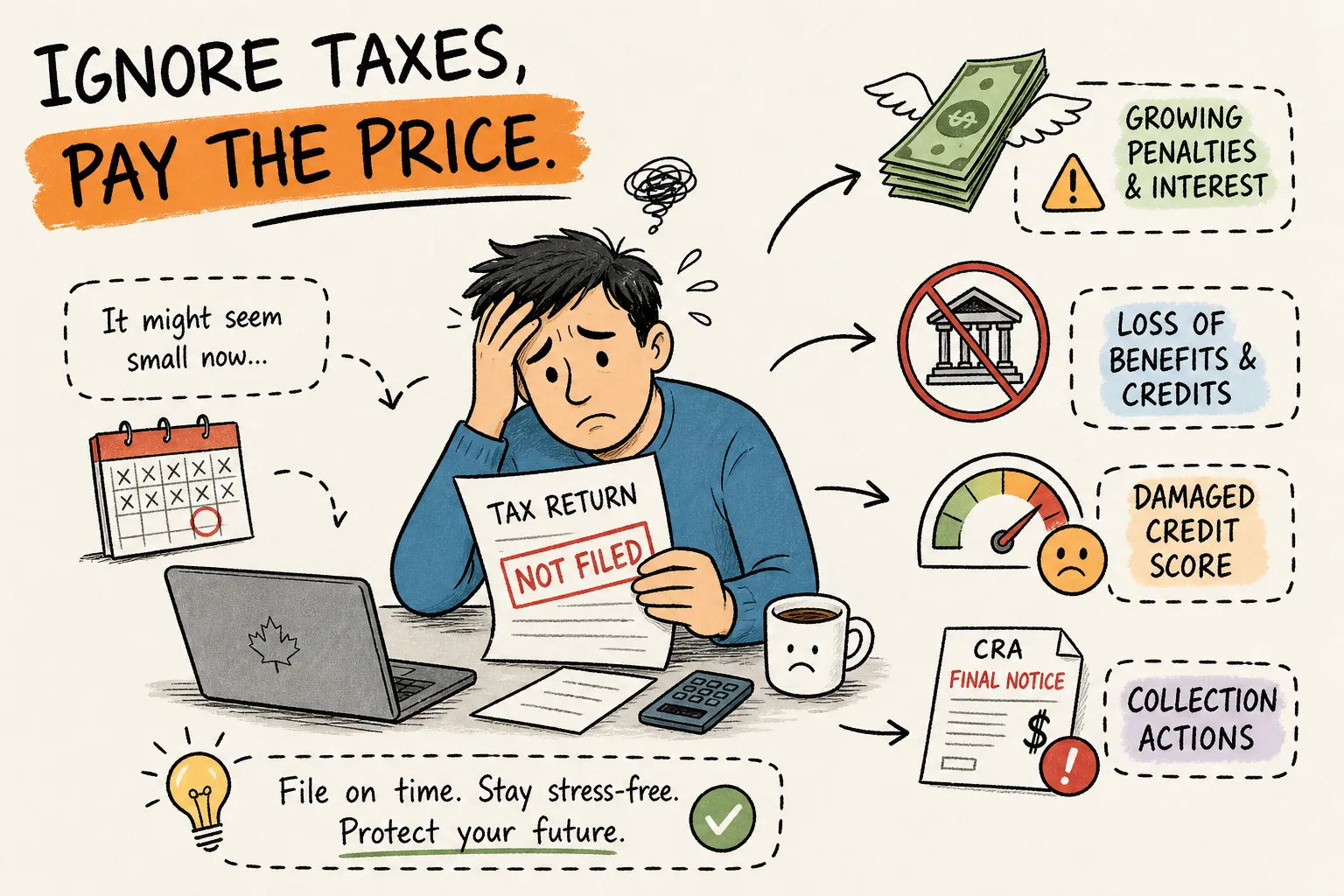
If you don’t file taxes in Canada, the CRA charges a late filing penalty of 5% of the balance owing plus 1% per month for up to 12 months, adds daily compound interest, can issue an arbitrary assessment with no deductions and stops benefits like the GST/HST credit and Canada Child Benefit. Repeat penalties double. Our catch-up tax filing service and guide to unfiled returns help Mississauga residents get compliant.
If you haven’t filed a tax return in Canada, whether for one year or several, the consequences are real, but they’re also predictable and solvable. What happens if you don’t file taxes in Canada follows a mechanical pattern: penalties accumulate, interest compounds daily, benefits stop, and the CRA’s enforcement tools eventually activate. None of that is personal. But it does get more expensive the longer you wait.
This article covers two groups: individual T1 filers and incorporated business owners with T2 obligations. The consequences differ in each case, but the core reality is the same. Penalties and interest are calculable, specific benefits, including the Canada Child Benefit, GST/HST credit, and provincial programs, stop until you file, and CRA enforcement follows a predictable escalation path. What you’re facing is a solvable problem, not a crisis, provided you act rather than wait.
Here’s what we’ll cover:
- The CRA’s penalty and interest formulas
- What unfiled T2 returns cost incorporated businesses specifically
- The government benefits that stop without a filed personal return
- How the CRA escalates from reminder letters to garnishment
- How to get back into compliance the right way
What happens if you don’t file taxes in Canada: penalties and interest
The CRA’s penalty and interest system is mechanical. It’s not personal. But that mechanical precision is exactly what makes it so costly when you ignore it, because the numbers compound whether you’re paying attention or not.
How the standard late-filing penalty formula works
The standard late-filing penalty for a personal return is 5% of the balance owing on the due date, plus 1% of that balance for each full month the return is late, to a maximum of 12 months. So if you owed $5,000 and filed six months late, the penalty is $250 (5%) plus $300 (1% x 6 months) for a total of $550. Two things matter here: the penalty only applies if you have a balance owing, and the monthly portion stops at 12 months. If you’re owed a refund, there’s no late-filing penalty, but you don’t get your money, and your benefit payments may stop.
What repeat late filers face
The CRA doubles the formula for repeat late filers. If you were assessed a late-filing penalty in any of the three prior years and you also received a formal demand to file, both conditions must be met, the penalty increases to 10% of the balance owing plus 2% per month, capped at 20 months. On that same $5,000 balance filed six months late, the penalty jumps to $500 plus $600, totaling $1,100. The CRA defines “repeat” based on its own records, not your sense of how often you’ve been late.
How daily compounding interest turns a small balance into a big one
On top of any penalty, the CRA charges interest at 7% annually for 2026, compounded daily from the day after your balance was due. Interest runs on the original balance owing plus any accumulated penalties. A $5,000 balance left unaddressed for two years doesn’t grow by a flat $700; it grows by more, because yesterday’s interest becomes today’s principal. The rate can change quarterly, and whatever rate applies to each period is what you’ll be charged for that period.
What unfiled T2 returns cost incorporated business owners
For incorporated businesses, the cost of not filing goes well beyond the standard penalty formula. Three separate problems compound simultaneously: the corporate late-filing penalty, lost dividend refunds, and personal director liability exposure. Any one of these is serious on its own. All three together create a significant financial and legal problem.
Corporate late-filing penalties: the T2 version
T2 corporate returns are due six months after the fiscal year end. The same 5% plus 1% per month formula applies, based on the balance owing, capped at 12 months, with the doubled formula applying when both repeat late-filer conditions are met. A corporation with no balance owing avoids the direct financial penalty, but the absence of a filed return creates its own problems. CRA cannot process your dividend refund or start the reassessment clock, regardless of whether tax was owing.
Forfeited dividend refunds (RDTOH)
The Refundable Dividend Tax on Hand (RDTOH) account tracks refundable tax that a CCPC has paid on investment income. That tax is refunded to the corporation when it pays taxable dividends to shareholders, but only if the T2 return has been filed to trigger the refund. The filing must happen within three years of the fiscal year end. File more than three years late, and the dividend refund for that year is denied. That’s real cash out of the corporation, not a theoretical loss.
Director liability: when the corporation’s problem becomes yours personally
Under the Income Tax Act and the Excise Tax Act, directors of a corporation can be held personally liable for amounts the corporation failed to remit: payroll source deductions (income tax, CPP, and EI withholdings) and GST/HST. This liability doesn’t disappear when the corporation is dissolved. The CRA has two years from the date you last ceased to be a director to assess you personally. Establishing a due diligence defense can be challenging once liability has accrued, directors should retain records and seek qualified advice well before problems escalate. If the corporation has no assets and unfiled returns, the director’s personal bank account is the next place the CRA looks.
Government benefits that disappear without a filed personal return
The CRA uses your filed T1 return to calculate and release government benefit payments. Without a filed return, it cannot calculate what you’re owed, so the payments stop. This affects every benefit tied to your annual filing, and for families receiving the Canada Child Benefit, the dollar impact is immediate and significant.
Canada Child Benefit: why payments stop without a filed return
CCB payments are calculated from your adjusted family net income as reported on your T1. Both spouses or common-law partners must file each year for payments to continue. If either partner misses a year, the CRA stops the payments. As an illustration: for a family receiving $700 to $1,000 or more per month in CCB, a single unfiled year could mean roughly $8,400 to $12,000 or more in suspended payments.
GST/HST credit and provincial benefit programs
The GST/HST credit requires no separate application. CRA calculates it automatically from your filed return. No return means no credit. The same logic applies to provincial benefits such as the Ontario Trillium Benefit, which also depends on a filed T1. Zero-income earners must file to receive any of these. Filing is the mechanism the system uses to pay you what you’re owed. Skip the filing, skip the payment.
How the CRA escalates from reminder letters to enforcement
The CRA doesn’t jump straight to garnishment. It follows a staged process, and understanding where you are in that process changes the urgency of your response.
The CRA’s staged escalation process
The sequence typically begins with reminder letters and requests to file. If those go unanswered, the CRA issues a formal demand to file. Responding to that demand with a late return, when you’ve also been assessed a late-filing penalty in any of the three prior years, is what triggers the doubled repeat-filer penalty formula. If you still don’t file after a formal demand, the CRA can issue an arbitrary or notional assessment: an estimate of your income and tax owing based on information in its possession, including T4s, T5s, and third-party filings. These arbitrary assessments are almost always unfavorable because they don’t account for deductions, expenses, or credits you would have claimed. Once assessed, the CRA transfers the file to collections.
Garnishment, bank account freezes, and property liens
Once a debt is assessed, the CRA has broad collection powers under the Income Tax Act. A Requirement to Pay notice sent to your employer diverts a portion of your wages directly to the CRA. A Requirement to Pay sent to your financial institution freezes and seizes funds in your account up to the amount owing. The CRA can also register a lien against real property, which blocks sales and refinancing until the debt is resolved. These tools are not threats. They are standard procedure once collections are involved.
Why unfiled returns mean the CRA can assess you for any prior year
The normal reassessment period for a T1, or a T2 filed by a CCPC, is three years from the date of the original notice of assessment. That clock starts when you file. If you never filed for a given year, the limitation period never begins. The CRA can assess that year at any point in the future, even 10 or 15 years later. Every unfiled year stays permanently open.
The Voluntary Disclosures Program
If you have years to catch up and the CRA hasn’t contacted you yet, the Voluntary Disclosures Program can reduce the penalties and interest. It doesn’t reduce the tax itself, and it generally isn’t available once the CRA has started an audit or enforcement. Who qualifies and how it works are covered in I haven’t filed taxes in 10 years in Canada.
How to file late and resolve back taxes in Canada: getting back into compliance
The first step is always to file, even if you can’t pay. Filing and paying are two separate problems. A balance owing can be addressed through a payment arrangement with the CRA, but the CRA generally won’t negotiate a payment plan while returns remain unfiled. Filing late stops the late-filing penalty from growing further. That alone is worth doing immediately, regardless of your situation.
File immediately, even if you can’t pay in full
Every month a return stays unfiled is another month of penalty accumulation and another month of daily compounding interest. Filing removes the penalty growth and gives you standing to arrange a payment plan. For individuals, filing also restarts your CCB and GST/HST credit payments. Prioritize getting the return in, then address the balance. The two problems are easier to solve separately than together.
For incorporated businesses: why a CCPC specialist matters
Reconstructing multiple years of unfiled T2 returns is not routine accounting work. RDTOH pools, GRIP balances, CDA elections, and SBD eligibility must be tracked in sequence across each year, as outlined in CRA guidance for CCPC-specific attributes. A calculation error in year one cascades forward into every subsequent year, compounding the original mistake. Generalist accountants who file T2s occasionally can miss these attributes, and the cost to a CCPC owner is real money in lost refunds and forfeited deductions.
Adian Professional Corporation specializes in T2 corporate returns and CCPC compliance. Every engagement is handled with the technical precision that CCPC-specific attributes require, not processed as routine paperwork. The firm works with incorporated business owners in Mississauga and the GTA on a fixed fee, confirmed in writing before any work begins.
The bottom line on unfiled returns
If you’re wondering what happens if you don’t file taxes in Canada, the answer is straightforward: penalties grow, interest compounds daily, benefits stop, and the CRA’s assessment window stays permanently open for every unfiled year. Waiting doesn’t make any of it easier, it makes it more expensive.
The action plan is clear: file what you can, start a catch-up tax filing if more than one year is open, consider the VDP if CRA enforcement hasn’t started, and get specialist help if you’re dealing with multiple unfiled T2 corporate returns. Every month of delay adds cost. Every unfiled year extends the CRA’s reach. The problem is solvable now, and harder to solve the longer you leave it.
If your incorporated business has unfiled T2 returns and you want this resolved correctly the first time, reach out to Adian Professional Corporation. We handle the technical reconstruction, the filing, and the CRA coordination, so you file correctly, once, and move on.