

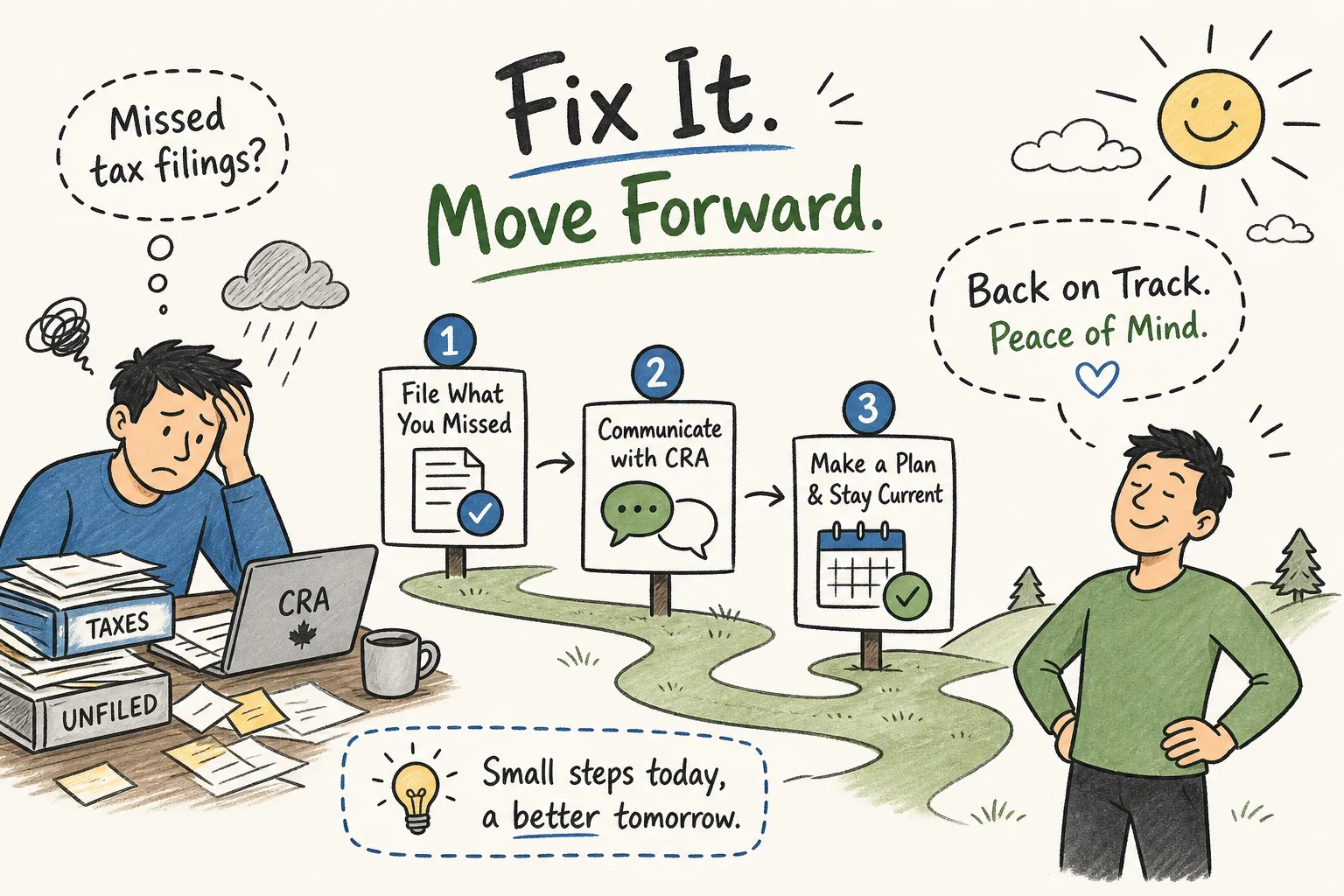
If you haven’t filed taxes in years in Canada, file as soon as possible because penalties and daily interest keep growing. Authorize a CPA to pull your CRA records, rebuild missing years, check whether the Voluntary Disclosures Program applies, then file oldest year first. Adian’s catch-up tax filing service handles overdue T1 and T2 returns for Mississauga individuals and corporations at a fixed fee.
If you haven’t filed taxes in 10 years in Canada, or three, or twenty, you’re not alone, and the situation is more manageable than it probably feels right now. Missing a year of taxes happens. Missing several years happens more than most people realize. Life gets complicated, a business gets busy, and before you know it, there’s a drawer full of unopened mail and a CRA account you haven’t looked at in years. The situation feels worse than it is. But it doesn’t get better on its own.
The penalty and interest clock doesn’t pause while you figure things out. Every month you delay, compound daily interest keeps accruing on any unpaid balance. The good news is that both personal filers and incorporated business owners have clear, available options for resolving unfiled years. The less good news: for incorporated business owners, the stakes are higher. Unfiled T2 corporate returns create a chain of corporate and personal tax problems that need to be unwound in the right order. Getting that sequence wrong adds time, cost, and CRA scrutiny to a situation that was already uncomfortable.
What are the first steps for someone who hasn’t filed Canadian taxes in a long time?
Start by confirming which years are actually missing. Before you file anything, you need to know what CRA has on file and what it doesn’t. Log in to CRA My Account for personal returns, or My Business Account for corporate returns, and pull up your filing history. The “Tax Returns” tab shows which years have an assessed return on record. A year with no return and no assessment means the clock hasn’t started on the normal reassessment period, because that period only begins once CRA issues a notice of assessment. That’s an important detail: unfiled returns have no reassessment protection until CRA processes them.
What you’re looking for is gaps: years where nothing was filed. For corporations, cross-reference your fiscal year-end calendar against the T2 filing history in My Business Account. An unfiled T2 year won’t always trigger an automatic assessment the way a personal T1 sometimes does. That means the problem can go undetected longer, but it doesn’t mean it goes away.
If you can’t access CRA’s online services, call the individual inquiries line at 1-800-959-8281 or the business inquiries line at 1-800-959-5525. (CRA phone numbers can change; confirm current contact information on the official CRA website before calling.) CRA can provide a statement of account and confirm which years are outstanding. Have your SIN or business number ready and be prepared to verify your identity and mailing address before they’ll share account details.
Gather What You Need to Reconstruct Each Unfiled Year
Personal T1 Filers
Once you know the missing years, the task is collecting documents. For personal T1 filers, that means income slips for each year: T4, T4A, T5, T3, T4E, and pension slips. You’ll also need RRSP contribution receipts and deduction records for medical expenses, childcare, donations, and tuition if applicable. Self-employed filers need income records, expense documentation, and business-use calculations on top of that.
Many taxpayers don’t have seven years of receipts organized in a filing cabinet. That’s fine. CRA My Account stores slip information going back several years, log in to see what’s available for your specific account, and financial institutions can often provide bank statements going back five to seven years, though retention periods vary by institution. Between those two sources, you can reconstruct a reasonable picture of income for most past years. The key rule: each tax year is filed separately using that year’s forms and rules. You don’t combine multiple years into one return.
Corporate T2 Filers
For incorporated business owners with unfiled T2 returns, the document list is more involved. You need annual financial records for each fiscal year (income, expenses, bank statements), prior-year T2s and financial statements for continuity schedules, and records of shareholder loans, dividends paid, and salary drawn. That last category matters for both the corporate return and the personal return. The T2 determines what income flowed to the shareholder, which directly affects the T1 calculation. File them out of sequence and you’ll end up with returns that don’t reconcile.
Decide Which Years to File First and in What Order
Not all missing years carry the same urgency, and the right sequencing depends on whether you’re owed refunds or whether you owe CRA money. If some of the missing years have refunds coming, file the oldest ones first. For personal returns, CRA has a 10-year limit on refund claims, so refund years beyond that window are gone. For corporations the window is shorter: a T2 filed more than three years after the year-end loses its refund. If the missing years involve balances owing and penalties are still accumulating, filing sooner reduces how much more you’ll owe.
One approach that tends to backfire: filing only the refund years and skipping the balance-owing years. CRA may scrutinize selective filing patterns, and filing selectively can undermine a later VDP application or trigger a prompted disclosure situation with reduced relief options. It’s worth understanding how CRA views your full filing history before deciding where to start.
For incorporated business owners, the sequence is more constrained. When corporate amounts affect your personal income, it’s generally recommended to file the T2 for a given fiscal year before the personal T1 for the calendar year that overlaps it. The corporate return establishes the salary and dividend history that flows through to the shareholder’s personal return. Filing the T1 first, without the T2 settled, means using numbers that aren’t confirmed yet, and that creates its own CRA correspondence down the road.
Understand the Penalties and Interest You’re Actually Facing
If a missing year has tax owing, a late-filing penalty applies, and it is higher for someone who has filed late before and has received a demand to file. Compound daily interest runs on any unpaid balance from the day after the filing due date. The full figures are in our post on what happens if you don’t file taxes in Canada.
Unfiled returns have no protective reassessment date until CRA processes them, and there’s no time limit at all if CRA can establish misrepresentation attributable to neglect or willful default.
If you owe CRA money but can’t pay in full immediately, payment arrangements are available. CRA accepts pre-authorized debit plans set up through My Account, and you can contact the collections line to discuss installment options.
Consider the Voluntary Disclosures Program Before You File Back Taxes
The VDP is the most underused option available to Canadians who’ve gone years without filing. The basic premise: if you come forward voluntarily before CRA starts an audit or investigation, CRA can waive or reduce penalties and may grant interest relief. Many taxpayers don’t know the program exists. Many who do know about it don’t use it because they assume they won’t qualify, that assumption is often wrong.
Eligibility requires that the disclosure be voluntary and complete, that it involve penalties or interest, and that it cover at least one full year past the filing due date. You also need to pay the estimated taxes owing with your application, or submit a formal payment arrangement request. Under the current VDP rules, CRA distinguishes between unprompted disclosures (where you come forward before any CRA contact) and prompted disclosures (where CRA has already reached out about potential non-compliance). Unprompted disclosures typically receive more generous penalty and interest relief; prompted disclosures offer more limited relief, but coming forward is still better than waiting for enforcement to begin.
One practical first step before formally submitting: CRA offers a free, informal pre-disclosure discussion via a callback option. This lets you assess eligibility and get a sense of how CRA would likely treat your specific situation before you commit to anything. For multi-year situations, especially those involving a corporation, that conversation is worth having before you file a single return.
A few situations that don’t qualify: returns that only generate a refund, applications already under active CRA audit, and requests simply to change a prior election. If you’ve already received CRA correspondence about potential non-compliance, whether your disclosure qualifies as unprompted or prompted depends on how far enforcement has progressed, that determination matters and isn’t always straightforward.
When to Handle This Yourself and When to Bring in a Specialist
Simple situations can often be resolved directly. One or two missing T1 years, straightforward employment income, no corporation involved, and CRA My Account slips available for reconstruction, if that describes your situation, standard tax software for prior-year returns combined with a call to CRA to confirm your filing history may be enough to file back taxes in Canada without professional help.
Multi-year situations involving a corporation are a different problem. The T2 affects the T1. The VDP application needs to be complete and accurate the first time, because completeness is a core eligibility condition. Salary and dividend history needs to be reconciled before any return can be filed. The sequence of the corporate and personal returns matters for every affected year. Getting any part of that wrong doesn’t just slow things down, it creates new CRA correspondence that extends the process and adds cost.
This is where a specialist CPA firm changes the outcome. At Adian Professional Corporation, this is the exact type of engagement we handle for incorporated business owners in Mississauga and the GTA. Each engagement is scoped in writing before work begins, priced at a fixed fee with no hourly surprises, and managed by a senior CPA rather than a junior staff member processing files at volume. For business owners who’ve been putting this off partly because of billing uncertainty, that fixed-fee structure removes one more reason to wait.
The Bottom Line
If you’ve been asking yourself what the first steps are for someone who hasn’t filed Canadian taxes in a long time, here’s the answer: check your CRA filing history, identify which years are missing, gather the documents needed to reconstruct each year, sequence the filings in the right order, understand what you owe in penalties and interest, and explore VDP if your situation qualifies. Unfiled Canadian tax returns are a solvable problem. None of those steps require panic. All of them require action.
For personal filers with a straightforward situation, the path is relatively direct. For incorporated business owners, the T2 and T1 interdependencies, the potential VDP application, and the corporate tax nuances make this a situation where the cost of getting it wrong exceeds the cost of getting qualified help. The longer the unfiled period, the more that’s true.
If you’re an incorporated business owner with multiple unfiled years and you want a clear scope, a fixed fee, and a CPA who handles the CRA communication directly, reach out to Adian Professional Corporation. We’ll tell you exactly what needs to be done and what it costs before any work begins.