

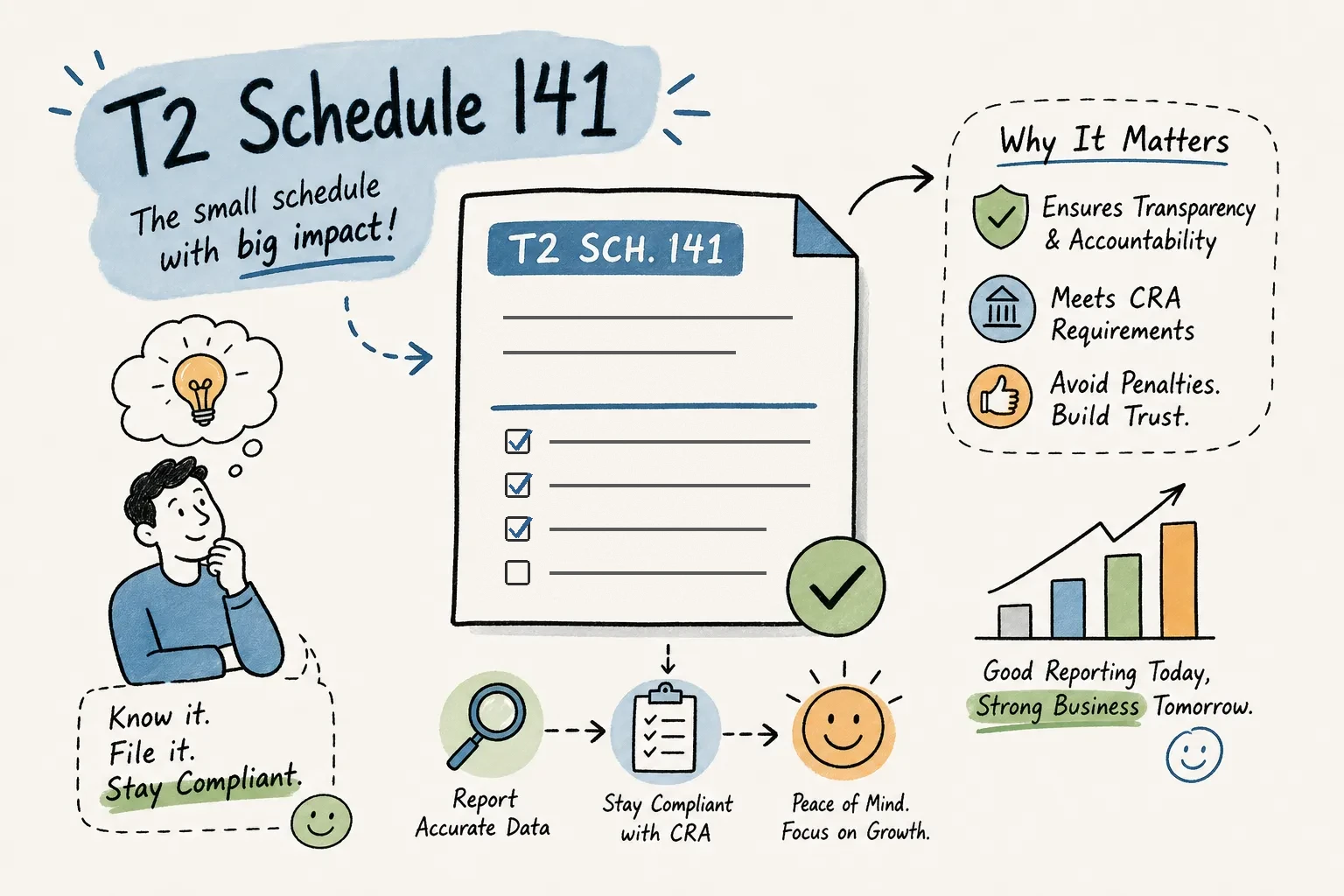
T2 Schedule 141, the GIFI notes checklist, tells the CRA who prepared a corporation’s financial statements, whether a CPA was involved, what type of engagement was performed, such as a compilation engagement, and whether notes are attached. Every corporation filing a T2 corporate tax return completes it alongside Schedules 100 and 125.
If you’ve ever wondered what is the purpose of T2 Schedule 141, you’re not alone. Many business owners overlook this schedule entirely, signing off on their T2 return without giving it a second look. It’s a checklist-style schedule with no dollar amounts on it, which makes it easy to underestimate. That’s exactly the problem. Schedule 141 is a formal disclosure to the CRA about who prepared your financial statements, how involved they were, and whether anything was flagged along the way. Getting it wrong doesn’t just create an administrative headache. It means your return contains an inaccuracy about the very foundation of the numbers you filed.
At Adian Professional Corporation, Schedule 141 is treated as a required disclosure that reflects the quality of work behind the entire return, not as a box to check before hitting send. The schedule tells CRA what stood behind your financials. If what you disclose doesn’t match reality, you’ve created an inconsistency that has no upside.
What Is the Purpose of T2 Schedule 141?
The GIFI Notes Checklist Explained
T2 Schedule 141 is formally titled General Index of Financial Information (GIFI) – Additional Information. Older versions of the form called it the Notes Checklist. The GIFI is the standardized system CRA uses to collect financial statement data electronically when you file your T2 return. Schedule 141 is the companion document that gives that data context. Where the GIFI schedules report your balance sheet and income statement figures, Schedule 141 answers the question: who produced those numbers, and how?
This schedule is not optional for most corporations. CRA says you have to include it even if you file your return using tax preparation software. It functions as a formal representation about the preparation of your financials.
What CRA Actually Wants to Know from This Schedule
The current form has five parts: who was primarily involved with the financial information, what type of involvement they had, any reservations in an audit or review report, other information about the notes to the financial statements, and who prepared the T2 return if that person has an accounting designation. CRA also asks you to include any notes to the financial statements and any auditor’s or accountant’s report, if they were prepared, even when you’re filing through tax software. The schedule creates the context; the attachments provide the evidence.
These answers matter because they tell CRA how much weight to give the financial information behind your return. A set of audited financials carries different implications than statements prepared by management with no external involvement. T2 Schedule 141 is where that distinction gets made, and why understanding the purpose of T2 Schedule 141 matters well before the filing deadline.
Which Corporations Are Required to File Schedule 141
The General Rule for T2 Filers
If your corporation filed a T2 return and had any financial statement information to report, you are required to complete Schedule 141. This applies even when there are no notes to attach. The size or simplicity of your corporation does not create an exemption.
This misconception exists among many business owners. Many assume that a straightforward, single-shareholder corporation with simple operations doesn’t need to worry about this schedule, that assumption is wrong. If your corporation was active during the tax year, plan to complete Schedule 141.
The One Real Exception: Inactive Corporations
CRA does recognize one narrow exception. Inactive corporations that had no activity throughout the entire tax year and have no balance sheet or income statement information to report are not required to attach Schedules 100, 125, and 141. CRA will accept those schedules if filed voluntarily, but they are not mandatory in that specific case. This exception applies to genuinely inactive corporations, not corporations that simply had a slow year or minimal revenue. If your corporation operated in any meaningful way during the tax year, assume the schedule is required.
Audit, Review, Compilation or None
Audit and Review: The Higher Assurance Standards
An audit is the highest level of assurance available. The CPA performs extensive testing, confirmation procedures, and evidence gathering, then expresses a positive opinion that the financial statements are fairly presented in all material respects. A review engagement is less intensive; the CPA performs inquiry and analytical procedures and provides limited assurance, stated in negative form, that nothing came to their attention indicating material misstatement. Both engagement types require the accountant’s report to be attached to the T2 filing. These are less common for small CCPCs, but they represent the top of the assurance spectrum that Schedule 141 can disclose.
Compilation under CSRS 4200: The Most Common CCPC Scenario
For most incorporated small business owners, a compilation engagement under CSRS 4200 is what their financial statements reflect. In a compilation, the CPA assembles financial information from data provided by management into a proper financial statement format. The CPA does not verify the numbers, does not perform testing, and provides no assurance. The engagement is about form and structure, not independent verification.
Under the CSRS 4200 standard, as outlined by CPA Canada, the compiled financial statements must include a note describing the basis of accounting used, and the CPA must attach a compilation engagement report (not the old “Notice to Reader” from prior standards). When Schedule 141 reflects a compilation engagement, that report must be attached to the T2 filing. If you receive a T2 package from your CPA and a compilation report is included, this is why it’s there. It is not optional under the current standard.
No CPA Involvement: When Management Prepares the Statements
In some cases, no external accountant was involved in preparing the financial statements at all. Management prepared the statements internally, and a CPA was engaged only to file the T2 return. This is a legitimate scenario, and corporate tax Schedule 141 can reflect it accurately. What it means in practice is that the financial data behind the return carries no external review, no compilation report, and no assurance of any kind.
Who Actually Counts as the “Person Primarily Involved”
Why the Tax Preparer Is Not Automatically the Accountant
This is one of the most frequently misunderstood aspects of Schedule 141. CPA Canada is clear on this point: preparing the T2 return does not make someone the accountant referred to on this form. The person primarily involved is whoever was most responsible for the financial information used in the return, meaning the person who prepared or reported on the financial statements themselves, not the person who used those statements to complete the tax return.
A CPA who received management-prepared financial statements, entered the GIFI data, and filed the T2 return is the tax preparer. They are not the accountant for Schedule 141 purposes unless they also prepared or reported on the underlying financial statements. Marking the wrong box here creates an inaccurate disclosure. It suggests a level of involvement that didn’t actually occur.
How to Identify the Right Person for Your Corporation’s Return
The decision is more straightforward than it sounds. If an external CPA completed an audit, review, or compilation of your financial statements, that CPA is the person primarily involved. If management prepared the statements internally and no accountant touched them, management is the answer, and Schedule 141 should reflect that. Ask yourself who was most responsible for the financial information, not who filed the return. Apply that question to your specific situation before the return is submitted.
What to Verify Before Your T2 Is Filed
Common Mistakes That Appear on Schedule 141
The errors that appear most often on Schedule 141 are not arithmetic mistakes, they are disclosure mistakes. Here are the ones that show up repeatedly:
- Marking the wrong level of involvement: Checking “compilation” when no CPA compilation engagement was actually completed, or listing an accountant when management prepared the statements
- Failing to attach the required report: A compilation engagement under CSRS 4200 requires the compilation report to be attached; leaving it out creates an immediate inconsistency
- Confusing the tax preparer’s role with the accountant’s role: These are not the same, and treating them as identical produces an inaccurate disclosure
- Applying the inactive corporation exception incorrectly: Assuming that because the corporation had minimal activity it qualifies as inactive for Schedule 141 purposes
- Inconsistencies across the return: Disclosures on Schedule 141 that don’t align with the GIFI financial data or other schedules in the T2 package
Each of these mistakes carries the same consequence: the schedule reflects something that didn’t actually happen, and the return contains an inaccuracy that creates exposure if CRA ever reviews the file.
Why This Matters More Than Most Owners Think
Schedule 141 is a formal representation to CRA about who stood behind your financial statements. It’s not a secondary attachment that exists for administrative reasons. When the level of involvement disclosed on Schedule 141 doesn’t match the engagement that was actually completed, the return contains a material inaccuracy at precisely the point where CRA is looking for disclosure.
At Adian Professional Corporation, accurate completion of Schedule 141 is a standard part of every corporate filing, not an afterthought. The correct level of involvement is identified, the required attachments are included, and the schedule aligns with the rest of the return. This is what a properly prepared T2 return looks like.
The Bottom Line on T2 Schedule 141
Understanding what is the purpose of T2 Schedule 141 comes down to this: it tells CRA who prepared your financial statements, how involved they were, and what supporting information backs up the numbers in your return. Most corporations must file it, even when there are no notes to attach. The level of assurance disclosed has real meaning. And identifying the correct “person primarily involved” is not a technicality, it’s the whole point of the form.
If you have questions about your filing before anything is submitted, that’s the right time to get clarity, not after the return is on record. Get in touch with our team at Adian Professional Corporation to discuss your T2 corporate tax return and make sure every part of the return, including Schedule 141, accurately reflects the work behind your financial statements.