

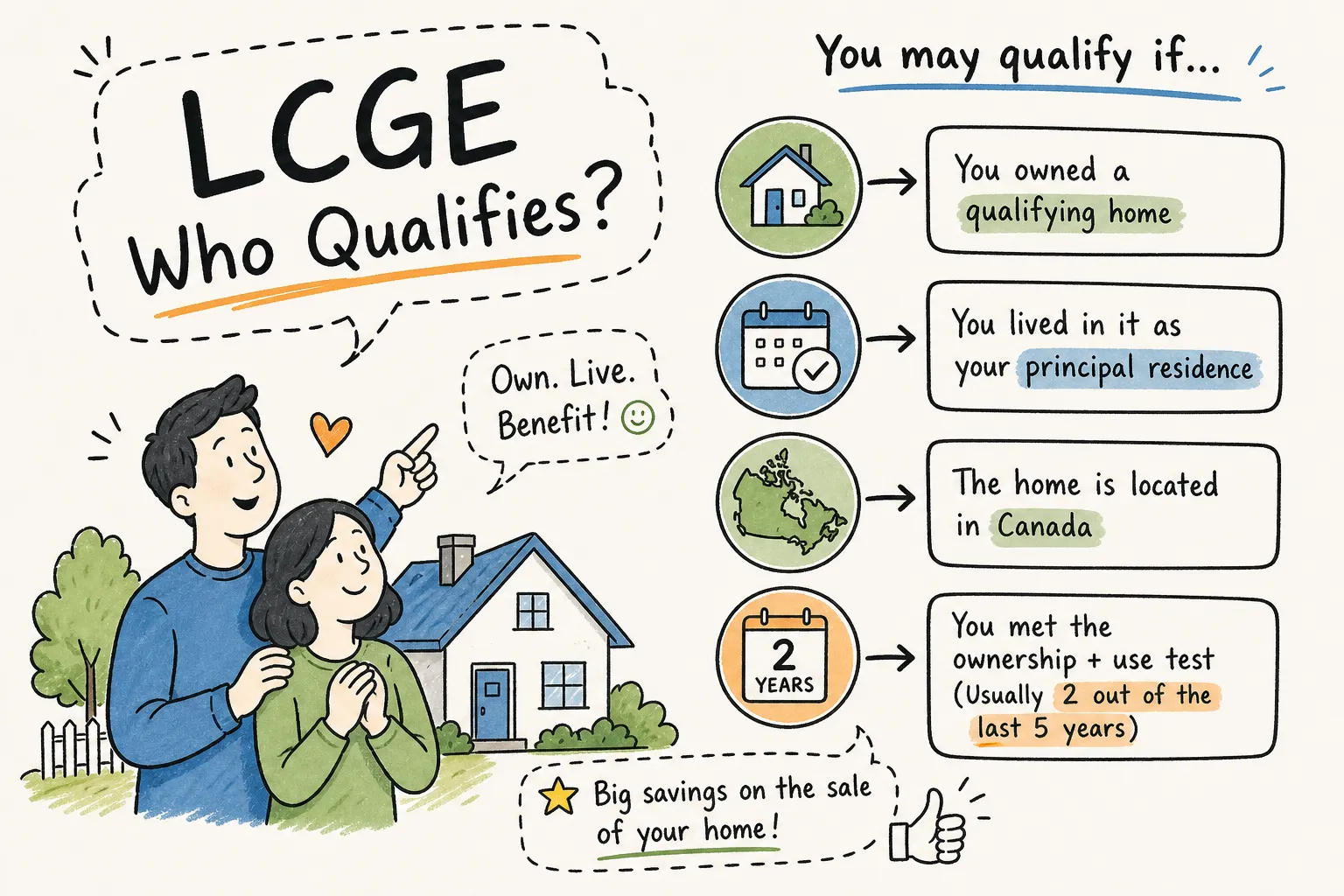
Canadian residents who sell qualified small business corporation shares can claim the lifetime capital gains exemption of about $1.25 million. The shares must be in a CCPC with 90% active business assets at sale, more than 50% active assets throughout the prior 24 months, and be held by you or a related person for 24 months. Owners often need business sale tax planning or a family trust to qualify and multiply it.
Who qualifies for the LCGE? That is the question every incorporated business owner should answer long before a sale is on the table. The Lifetime Capital Gains Exemption offers Canadian business owners up to $1,275,000 of eligible capital gains completely sheltered from tax in 2026. But it is not a benefit you receive automatically by owning shares in a private corporation. The CRA applies three distinct tests to every claim, and failing any one of them eliminates the entire exemption on the sale. Not a portion. All of it.
The problem is that most CCPC owners discover they have an eligibility issue weeks before closing, when there is nothing left to fix. The tests are retroactive. They look back 24 months. You cannot repair an ownership history or clean up a passive asset problem in the final stretch of a transaction. This article breaks down exactly who qualifies for the LCGE, what each test requires, and why the right time to think about this is years before a sale is even on the table.
At Adian Professional Corporation, structured LCGE planning is a core part of the work done with incorporated business owners. The common patterns that cause owners to miss the exemption are well-documented in tax practice, and they are all preventable with enough lead time.
Who qualifies for the LCGE: what it covers and the 2026 exemption amount
The Lifetime Capital Gains Exemption applies to three categories of property: qualified small business corporation (QSBC) shares, qualified farm property, and qualified fishing property. All three share a single lifetime limit. Farm and fishing property follow a parallel structure but with different use, ownership, and gross revenue tests specific to those industries. This article focuses on QSBC shares, which is where the vast majority of incorporated business owners land.
The 2026 exemption amount is $1,275,000 of eligible capital gains. That figure reflects the federal increase to $1,250,000 for dispositions on or after June 25, 2024, with annual indexation resuming in 2026. Since only half of a capital gain is taxable under the current inclusion rate, the capital gains deduction available on Line 25400 of your T1 return shelters approximately $637,500 from tax. This is a lifetime limit across all qualifying dispositions, not a per-sale allowance. Prior claims reduce what remains available to you.
Test 1: The 24-month ownership and holding period rule
Who qualifies for the LCGE, ownership requirements explained
For the 24 months immediately before the disposition, the shares must have been owned by the individual claiming the exemption or by a related person. Related persons include a spouse, common-law partner, and certain family members. An unrelated party cannot have held the shares at any point during that window. This rule exists to prevent someone from purchasing shares in a corporation already set up for a sale and then claiming an exemption on a gain they had no part in building.
The most common way this test fails is a prior arm’s-length shareholder appearing somewhere in the 24-month look-back period. Corporate reorganizations that introduced new share classes, estate transfers, or spousal rollovers need to be timed carefully to avoid resetting the clock. If the ownership history is clean and continuous within the related-person group, this is generally the most straightforward of the three tests to satisfy. The challenge is that many owners never audit their ownership history until a transaction is imminent, and by then the window has already closed.
Test 2: Active business asset measurement over the prior two years
How the 50% active asset test works under LCGE rules 2026
Throughout that same 24-month period, more than 50% of the fair market value of the corporation’s assets must have been used principally in an active business carried on primarily in Canada. This is measured across the entire 24-month window, not just at the closing date. A corporation that drifts in and out of compliance at various points during those two years creates a problem even if the balance sheet looks clean at the time of sale.
Passive assets are the main threat here. Excess cash sitting in the operating company, marketable securities, shareholder loans receivable, and rental real estate all count as non-qualifying assets. As retained earnings accumulate and passive holdings grow, the fair market value of qualifying active assets falls as a proportion of total assets. Many profitable CCPCs quietly drift toward and below the 50% threshold over several years without the owner ever noticing. Per CRA’s administrative position, cash is only treated as active when it is genuinely needed for business operations, planned capital expenditures, or debt repayment. Surplus cash does not qualify.
Shares in and debt owed by connected corporations can count toward the active business asset pool under certain conditions. This matters for business owners operating through a holding company or multiple related entities. Most generalist accountants miss this entirely, which means the planning flexibility it creates often goes unused.
Test 3: The all-or-substantially-all requirement at the time of sale
At the moment the shares are disposed of, the corporation must be a Canadian-controlled private corporation and a small business corporation. That means all or substantially all of its assets, which CRA administratively interprets as approximately 90% by fair market value, must be used mainly in an active business carried on primarily in Canada. This threshold is materially higher than the 50% required during the prior 24 months, and it is evaluated as a standalone snapshot at closing, not as a continuation of the two-year average.
This is the test that catches the most owners off guard. A corporation that maintained 55% active business assets throughout the two-year look-back period would technically pass Test 2 but fail Test 3. The gap between 50% and 90% is not a technicality. It is a meaningful difference in how the balance sheet needs to look. Corporations carrying significant retained earnings in passive investments are the most common casualty at this stage.
Addressing this requires a purification strategy: removing passive assets from the operating company before the sale. CRA accepts bona fide, legally effective transactions that actually shift assets, including paying dividends to extract excess cash, transferring passive holdings to a holding company, repaying shareholder loans, or using surplus cash to acquire active business assets. What CRA does not accept is paper-only journal entries that reclassify assets without any actual economic change. The purification also needs to happen well before closing. A last-minute transfer done days before a sale is both legally thin and a reliable audit trigger.
Why CCPC owners lose the exemption and how to keep it
Four patterns come up repeatedly in LCGE eligibility failures. Accumulated passive cash from retained earnings pushes the corporation below the 90% threshold at the time of sale. Purification attempts are made too close to the closing date to be defensible. The ownership history introduced an unrelated party at some point in the prior 24 months, often through a reorganization that was never reviewed for LCGE impact. And documentation is absent or incomplete, leaving the asset-test calculations unsupportable if CRA reviews the claim.
The three tests are retroactive. You cannot fix a 24-month ownership problem in the final month before closing. Purification needs time to restructure the balance sheet, and that restructuring needs to be positioned as a normal business decision rather than a transparent tax maneuver. Start this process at least two to five years before an anticipated sale, that is the standard planning horizon, and there is no good reason to wait. The owners who walk away with the full exemption treated it as a multi-year structuring exercise, not a filing-time calculation.
Adian Professional Corporation works with CCPC owners specifically on this kind of advance planning. LCGE planning engagements at the firm deliver a written plan with ITA section references, documenting the corporation’s current asset position, identifying what needs to change, and laying out the timeline required to satisfy all three tests before a disposition. The plan is produced before any work begins, and fees are fixed in writing so there are no surprises. Getting that structure in place early is the difference between claiming the full exemption and missing it entirely.
How to claim the LCGE, qualifying and filing when the time comes
The capital gain from the share disposition is reported on Schedule 3. Form T657 is used to calculate the lifetime capital gains deduction, and the result is claimed on Line 25400 of the T1 return. If you have investment income or investment expenses from any year between 1988 and your current filing year (2026 for returns filed this year), Form T936 is also required to calculate your Cumulative Net Investment Loss. CNIL reduces the available deduction dollar for dollar: if your qualifying gain is $500,000 and your CNIL balance is $80,000, your effective deduction is based on $420,000, not the full gain.
The documentation that supports the claim includes purchase and sale agreements, share certificates, corporate records showing asset composition over the 24-month period, adjusted cost base calculations, and working papers for Form T657 and T936. CRA will ask for all of this on review. The time to build this file is during the planning phase, before the sale closes, not afterward when the records need to be reconstructed from memory.
One common filing mistake is claiming Line 25400 without completing Form T657, or forgetting to report the gain on Schedule 3 entirely because the exemption is expected to shelter it. The gain still needs to be reported. Another mistake is ignoring the CNIL calculation, which can significantly overstate the available deduction if investment expenses have accumulated over prior years.
Plan for this now, not later
The Lifetime Capital Gains Exemption is one of the most significant tax benefits available to a Canadian business owner. But qualifying for it requires a corporation that was properly structured, held, and documented over a period of years. The three tests, covering ownership history, active asset composition over 24 months, and the all-or-substantially-all threshold at disposition, all need to be satisfied simultaneously. Missing any one of them costs the entire exemption on the sale.
If you want to confirm who qualifies for the LCGE before you sell, the time to assess your eligibility is now. Not when the letter of intent lands. Now. Adian Professional Corporation provides structured LCGE planning engagements for incorporated business owners across Canada, with a written plan and clear ITA section references delivered for every engagement. Contact Adian Professional Corporation before the window closes.
Frequently asked questions about LCGE eligibility
Who qualifies for the LCGE?
To qualify for the Lifetime Capital Gains Exemption in Canada, you must be a Canadian resident individual who disposes of shares in a qualified small business corporation (QSBC), qualified farm property, or qualified fishing property. For QSBC shares, the corporation must pass three tests: a 24-month ownership requirement, a 50% active business asset test measured over the prior two years, and a 90% active asset threshold at the exact moment of sale.
How do I prove I qualify for the LCGE?
Proof of LCGE eligibility is built from corporate records, not assembled after the fact. You need share ownership documentation covering the full 24-month period, asset composition records showing the corporation’s active-to-passive ratio throughout that window, and working papers supporting Form T657 and T936. CRA can request this documentation on review, and claims without supporting records are difficult to defend.
Can I still qualify for the LCGE if my corporation holds passive investments?
It depends on the amount. The corporation needs more than 50% of assets in active business use throughout the prior 24 months, and at least 90% at the time of sale. If passive holdings have accumulated, excess cash, marketable securities, rental properties, purification may be required before the sale. That process takes time and needs to reflect genuine economic transactions, not paper-only reclassifications.