

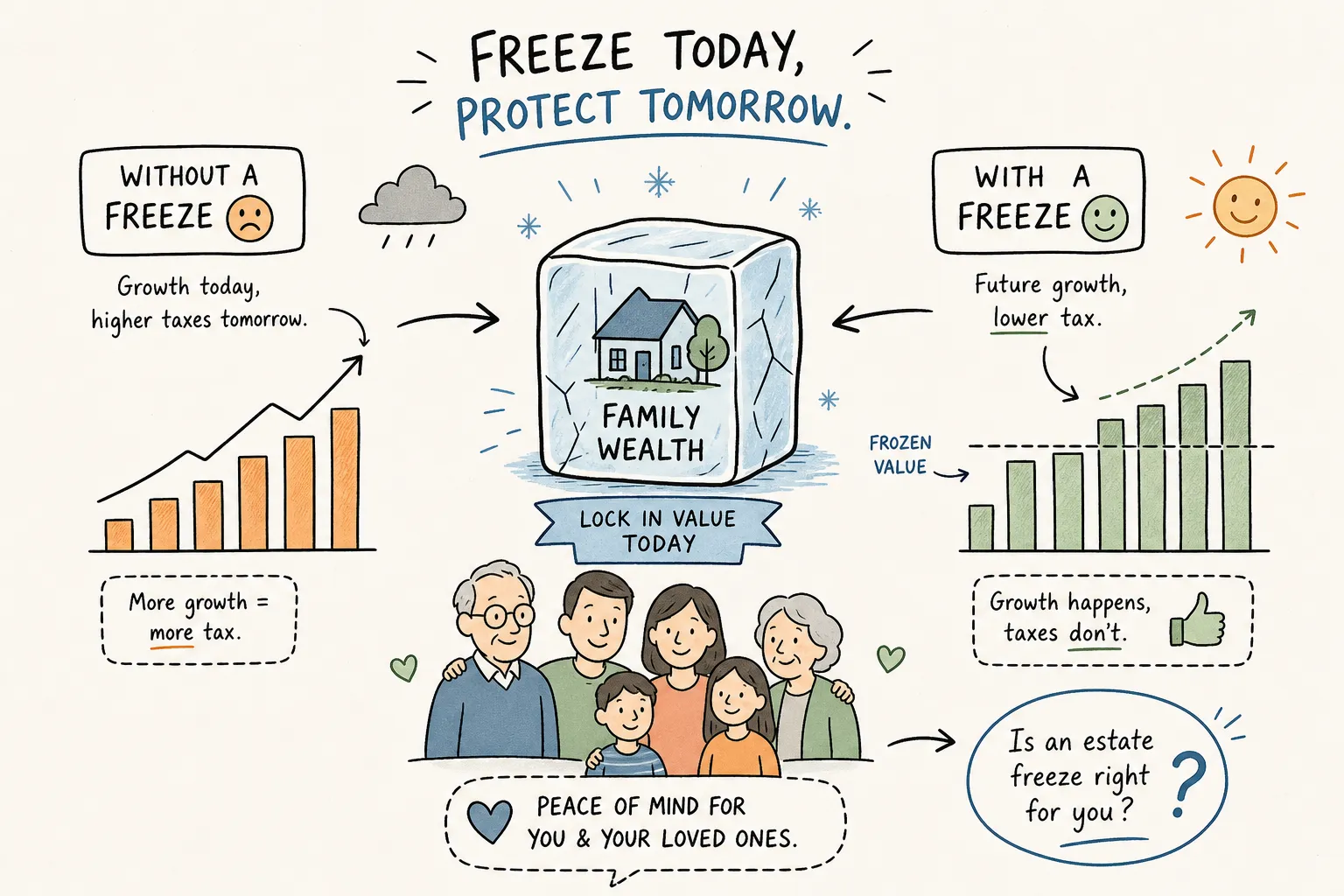
An estate freeze locks in the current value of a business owner’s shares by exchanging common shares for fixed-value preferred shares, usually under section 86 of the Income Tax Act. New common shares go to children or a family trust, so future growth and the related tax on death shift to them. Mississauga CCPC owners implement freezes through a corporate reorganization.
When a private corporation grows, so does the tax bill waiting for your estate. Most incorporated business owners don’t think about it until they’re already deep into their peak earning years, and by then, the window to plan effectively is narrowing. The problem is predictable: you die, your shares are deemed disposed of at fair market value, and your estate faces a capital gains bill on every dollar of growth your company produced. Without planning, that number is whatever your business is worth the day you die.
Incorporated business owners constantly ask what an estate freeze is, how it works in Canada, and whether it actually makes sense for their situation. This article covers the mechanics, the three structures you’ll encounter, the real tax consequences, and how to know whether you’re a candidate.
How a Canadian estate freeze actually works
What “freezing” your company’s value really means
The owner isn’t selling anything. The core transaction is an exchange: the owner trades their growth-bearing common shares for fixed-value preferred shares whose redemption value equals the company’s current fair market value. This preferred share exchange is the foundation of every corporate freeze. After the freeze, those preferred shares stay flat. Any future increase in the company’s value shows up in a different share class, not in the owner’s hands.
The practical benefit is tax predictability. The gain the owner will eventually face on death is now a known number. It’s capped at the frozen value established on the freeze date, not some unknown future figure that keeps growing the longer the owner lives. That certainty is what makes the freeze worth planning around.
The role of new common shares in the freeze structure
The “growth” side of the freeze is handled by new common shares, usually issued to children or a family trust for a nominal amount, sometimes as little as $1 to $100 total. From that point forward, every dollar of appreciation in the business flows to those new common shares. The owner retains economic value equal to today’s fair market value, and the next generation inherits the upside.
The three freeze structures you’ll actually encounter
Section 86 share-for-share exchange
This is the simplest approach: the entire transaction happens inside the existing corporation. The owner exchanges old common shares for new fixed-value preferred shares, and new growth common shares are issued inside the same company. This share freeze is usually tax-deferred under Section 86 of the Income Tax Act if the conditions are met. This structure works best for straightforward owner-managed corporations where there’s no need for a holding company layer.
Section 85 rollover into a holding company
Here, the owner transfers property or shares into a new holding corporation on a rollover basis. Preferred shares are taken back as consideration, and new growth common shares are issued in the Holdco. Section 85 of the Income Tax Act allows the transfer to proceed at elected values, deferring immediate tax. This structure suits owners who want a Holdco layer for asset protection, income splitting, or additional planning flexibility down the road, and it’s one of the most common vehicles for an intergenerational business transfer in Canada.
Issuing growth shares to a family trust
Instead of issuing new common shares directly to children, the shares are issued to a discretionary family trust that names family members as beneficiaries. A trustee controls how future growth is eventually distributed and to whom. This family trust estate freeze structure gives the family more flexibility over which beneficiaries receive value and when, which matters especially for families with younger children or complex dynamics around succession.
What the tax actually looks like
Capital gains deferral, not elimination
An estate freeze doesn’t make tax disappear. It defers the liability and shifts who pays, and when. On the freeze date itself, the exchange is structured to be tax-neutral using a rollover provision, so no immediate gain is triggered. At death, the owner faces a deemed disposition on the preferred shares at their frozen value, the same number established on the freeze date. Future growth is taxed in the hands of the new shareholders when they eventually sell or die. The owner’s estate is still on the hook for tax, but on a known, manageable number rather than a potentially massive one.
Two technical risks that can derail the plan
Section 84.1 is a risk that catches owners off guard. When a freeze is done between related parties, this anti-avoidance rule can recharacterize what looked like a capital gain into a deemed dividend, which is taxed at a higher rate and can eliminate access to the Lifetime Capital Gains Exemption. The rule applies most often when shares are transferred to a corporation controlled by a family member rather than through a straightforward internal reorganization.
TOSI, Tax on Split Income, is the other constraint. Income splitting benefits through a family trust are tightly restricted under TOSI rules. A freeze structured to take advantage of income splitting needs to be tested carefully against these rules, or the expected savings simply won’t materialize. Beneficiaries who haven’t made substantial contributions to the business often don’t qualify for the exclusions, meaning distributions to them get taxed at the highest marginal rate. The structure matters as much as the concept. A poorly executed freeze can produce results that are worse than doing nothing.
Honest pros and cons before you commit
What a freeze gives you
Tax predictability is the main benefit. You know the gain that will be taxed at death, which means you can plan liquidity for it rather than leaving your estate scrambling. Preferred shares can carry voting rights, so the owner often keeps operational control while economic upside moves to the next generation. That combination of retained control and shifted growth is difficult to replicate with other planning tools.
A freeze also starts the succession process while the owner is still active and able to mentor successors. It creates momentum without forcing a sale. And if the shares qualify as small business corporation shares, the frozen value may be eligible for the Lifetime Capital Gains Exemption, which can significantly reduce the eventual tax hit.
What you’re giving up or accepting
Flexibility decreases after a freeze. Restructuring is possible, but every adjustment adds legal and tax cost. The more time passes and the more the company grows after the freeze, the more expensive it becomes to unwind or revise the structure. Going in, you should treat the structure as close to permanent.
Tax is shifted, not gone. The next generation inherits the growth shares along with the future tax liability that comes with them. If a family trust is involved, annual trust returns, T3 slips, and beneficiary allocations become permanent additions to your compliance workload. And deciding which children get what, when, and how much can create family friction that a freeze formalizes rather than resolves.
When an estate freeze is actually worth doing
Signs you’re in the right window
The clearest signal is a growing company with more growth ahead. A freeze on a $5 million business that doubles over the next decade moves $5 million out of your estate permanently. If growth has already slowed or peaked, the math is less compelling.
Owners in their 50s or 60s who are actively thinking about succession benefit most from earlier freezes, there’s more time for growth to shift meaningfully to the next generation. A freeze also makes strong sense when your estate is large enough that a deemed disposition at death would create a tax bill that the estate might struggle to pay without selling the business. Finally, you need identified successors, whether family members or a trust structure, who can receive the growth shares in a credible and defensible way.
When it makes more sense to wait
If the business is still in an early stage and value hasn’t stabilized, freezing prematurely can lock in a low fair market value that creates awkward dynamics later or requires a costly refreeze. If family relationships or succession intentions aren’t clear yet, issuing growth shares to the wrong structure creates problems that are expensive to unwind. If a significant corporate reorganization is already underway, complete that first before adding a freeze layer on top.
What implementation actually involves
Documents, valuation, and timeline
A defensible fair market value determination is the foundation of the entire transaction. A Chartered Business Valuator or a detailed CPA valuation memo establishes the freeze price that everything else is built around. If the freeze value is set too low, the CRA may assess a benefit; too high, and the owner creates an unnecessary taxable gain. There’s no shortcut on this step.
The legal documentation includes a share exchange agreement, board and shareholder resolutions, articles of amendment creating the new share classes, and updated share certificates and minute book records. If a trust is involved, a trust deed and trustee appointments are also required. If a Section 85 rollover is used, a CRA election form must be filed by the prescribed deadline, which is generally tied to the tax return filing deadline of the transferor. From initial planning to signed documents and filed elections, a straightforward freeze typically takes six to twelve weeks. More complex structures with trusts and multiple shareholders take longer.
The professional team you need and what to expect
A corporate and tax lawyer drafts the reorganization documents and handles the share structure. A business valuator provides the fair market value support. A CPA handles the tax modeling, election coordination, and ongoing compliance. For a straightforward freeze, combined professional fees commonly run between $15,000 and $40,000 in legal, valuation, and tax planning costs. Complex structures cost more.
What matters as much as cost is documentation quality. A rigorous tax planning engagement should include a written plan with Income Tax Act section references for every structural decision, not just a verbal recommendation. Adian Professional Corporation builds that standard into every structured tax planning engagement. That level of written documentation is what protects the client if the CRA ever scrutinizes why the transaction was structured the way it was. Before hiring any advisor, ask directly: will I receive a written plan with ITA references? The answer tells you a great deal about the level of professional care you’re about to receive.
The bottom line on estate freezes
An estate freeze is a planning tool, not a tax elimination strategy. It gives you control over a number you’d otherwise have no say in, and it lets you shift future growth out of your estate while you’re still positioned to manage the process. That’s real value. But it’s not magic, and it’s not right for every business or every family.
If you’re asking what is an estate freeze and how does it work in Canada, the honest answer is that it’s a powerful deferral mechanism, one that works best when there’s still significant growth ahead. Waiting too long reduces the benefit substantially. If you’re a Canadian private corporation owner with a growing business and a succession horizon in the next ten to twenty years, the right next step isn’t a ballpark conversation. It’s a proper valuation and a written freeze analysis that lays out the mechanics, the tax consequences, and the structure in plain language with specific ITA references. That’s the standard the work deserves.